Side A · Liner notes
White Sox End Season with Disappointment: Analyzing Game 5 and Key Player Performances
Basketball · Words by Jim Margalus · Released
The White Sox's season concluded in Game 5 against the Guardians, marred by strikeout woes and missed opportunities. Key performances and tactical choices defined their fate.
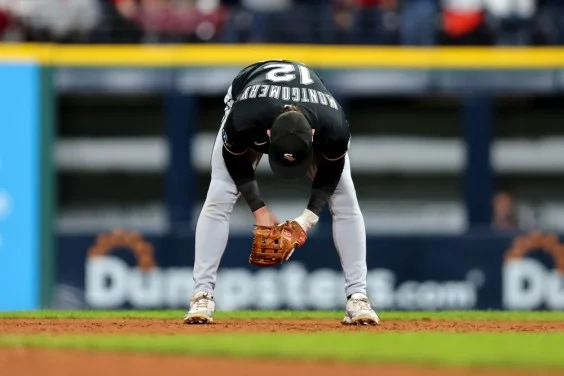
The White Sox faced their final curtain call of the 2026 season in a heartbreaking Game 5 against the Guardians. With runners on first and second, Miguel Vargas stepped up in the sixth inning with two outs, marking what would be the White Sox's last real scoring opportunity. He took a first-pitch slider from Gavin Williams that was initially called a strike, prompting him to challenge the call, which was ultimately overturned. Vargas would later draw a walk after watching a few more sliders, but the moment encapsulated the struggles of the White Sox throughout the series.
Despite Vargas’s ability to navigate a challenging at-bat, the White Sox lineup proved ineffective against the Guardians' pitching staff, especially targeting Munetaka Murakami, who managed to strike out an alarming 15 times over 23 plate appearances in the postseason after a notable Game 1 performance. Manager Will Venable's decision to go with his regular lineup appeared to leave vulnerabilities, particularly as left-handed hitters like Andrew Benintendi struggled significantly against Williams.
Lineup Decisions and Tactical Breakdown
The tactical choices in Venable's final lineup of the year came under scrutiny as it became clear the Guardians were exploiting Murakami while the White Sox lacked an adequate countermove. The overall team performance in the postseason highlighted a concerning trend as strikeout rates sharply increased. Notably, Andrew Benintendi saw an alarming rise in his strikeout rate from 23.9% in the regular season to a staggering 100% in the postseason. Others, like Braden Montgomery and Kyle Teel, also experienced similar or worse declines in their batting metrics.
| Player | Postseason | Regular |
|---|---|---|
| Andrew Benintendi | 100.0 | 23.9 |
| Braden Montgomery | 56.3 | 19.7 |
| Kyle Teel | 52.4 | 35.4 |
| Munetaka Murakami | 52.4 | 35.4 |
| Randal Grichuk | 45.5 | 20.6 |
| Colson Montgomery | 44.4 | 35.6 |
| Tristan Peters | 40.0 | 18.3 |
| Chase Meidroth | 40.0 | 21.9 |
| Brenton Doyle | 36.4 | 33.0 |
| Tommy Pham | 20.0 | 31.4 |
| Miguel Vargas | 13.6 | 17.9 |
| Sam Antonacci | 11.1 | 14.7 |
| Team | 40.5 | 24.1 |
With glaring mismatches in their hitting approach, options for Venable were limited when it came to lineup adjustments. Although Vargas and Sam Antonacci demonstrated some resilience at the plate throughout the series, the majority of White Sox hitters struggled to make consistent contact against the Guardians' pitching. Given the immense strikeout totals—19, 12, and 21 in the last three games—a shake-up to slotting Vargas higher in the order might have offered a more balanced approach.
Benintendi’s Struggles Highlight Bigger Issues
Andrew Benintendi’s collapse during the postseason is a concern for the White Sox as they assess their roster moving forward. After a promising start to the season and a significant reduction in his role, Benintendi ended September with a disappointing .189/.267/.302 line. He failed to record a hit throughout the series against Cleveland, striking out all seven times he stepped to the plate. His experience had been seen as invaluable earlier on, but now, with a year and $14.5 million left on his contract, the front office faces decisions regarding his future with the team.
Benintendi's struggle to adapt to a league now filled with higher-velocity pitches highlights a broader issue for aging players in a rapidly evolving game. In 2016, the average four-seam fastball velocity was around 94 mph; by 2026, that number skyrocketed to 96.3 mph, placing further burden on players who were once adept at hitting. As the team transitions into their offseason rebuilding phase, the question remains whether Benintendi will fit into their plans or if a move is necessary for progress.
Final Outcomes Reflect Player Performance More Than Managerial Decisions
While it's easy to analyze and critique Will Venable’s lineup and in-game decisions, the reality is that ultimately the players must execute when it matters. The shortcomings during the series were perhaps more a reflection of player performance than any managerial misstep. In the last three games, it was clear that the White Sox pitchers struggled with command and the hitters failed to capitalize on prime opportunities, including a critical moment when José Ramírez connected on a pitch well outside the strike zone.
As frustrating as this may be for the White Sox organization and their fans, the fact that they had gotten as far as they did despite these challenges was commendable. The lessons learned during this playoff run will be essential as they begin to rebuild and reshape the team's future. With an offseason that promises to bring new strategies and changes, the core group of players must take ownership of their performances moving forward, understanding that the burden of success rests on their shoulders.


